(888) 732-5250
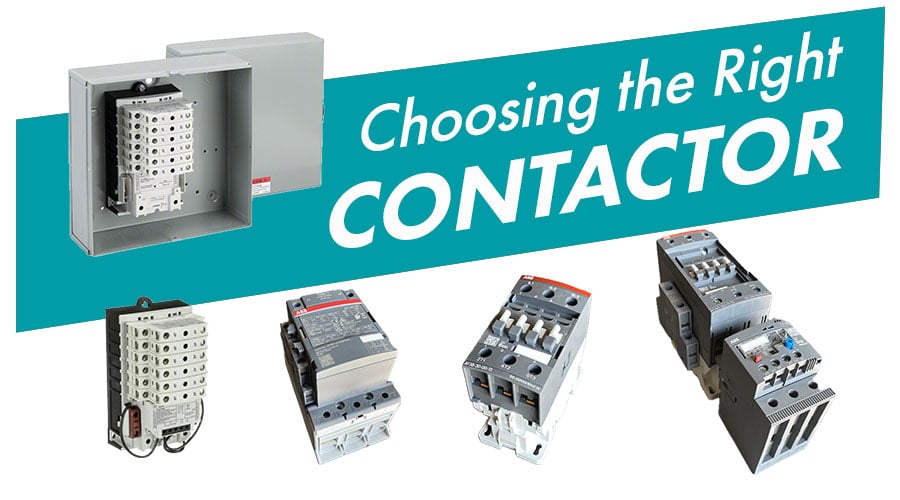
Contactors are used throughout commercial and industrial electrical systems to control motors, pumps, HVAC equipment, lighting systems, machinery and other electrical loads. While their basic function is relatively simple—switching electrical power on and off—the right contactor depends heavily on the equipment being controlled and the demands of the application.
Bay Power supplies contactors for motor control, lighting, HVAC and other commercial and industrial applications, with both NEMA and IEC options available. As an authorized ABB distributor, we maintain inventory of ABB contactors and related motor-control components while also supporting current and legacy equipment from other major manufacturers.
Understanding the major types of contactors and where they're commonly used can make it easier to select equipment for a new installation or identify the correct replacement when an existing contactor fails.
What Does a Contactor Do?
A contactor is an electrically operated switching device used to repeatedly connect and disconnect power to an electrical load.
Instead of requiring someone to manually switch the power circuit, the contactor responds to a control signal. That signal might come from a pushbutton, thermostat, pressure switch, PLC, building automation system or another control device.
This allows contactors to control equipment automatically or remotely.
Common applications include:
- Electric motors
- Pumps and fans
- Compressors
- Conveyors
- HVAC and refrigeration equipment
- Industrial machinery
- Commercial and industrial lighting
- Electric heating equipment
- Process and production equipment
A contactor may operate as an individual component or as part of a larger motor starter, control panel, motor control center or automation system.
One important distinction is that a contactor primarily performs the switching function. In a typical motor application, the contactor is paired with an appropriate overload relay to create a motor starter.
Motor Contactors: A Workhorse of Industrial Control
Motor control is one of the most common applications for contactors.
When a motor needs to start or stop, a contactor allows a relatively low-power control circuit to switch the much larger electrical load required by the motor.
Motor contactors are commonly used with:
- Pumps
- Fans and blowers
- Conveyors
- Compressors
- Industrial machinery
- HVAC equipment
- Processing equipment
- Agricultural equipment
- Manufacturing systems
For a straightforward across-the-line motor starter, the contactor performs the switching while an overload relay helps protect the motor against sustained overload conditions.
More complex applications can use multiple contactors for functions such as reversing a motor or other control arrangements.
Because motors place different demands on switching equipment than resistive or lighting loads, contactors should be selected according to the actual motor and application requirements rather than based on ampere rating alone.
ABB AF Contactors for Motor and Power Control
The ABB AF Series is a major part of Bay Power's current contactor offering and one of the product families we physically stock.
ABB AF contactors are available for motor starting and general power-switching applications. The range includes 3-pole and 4-pole configurations as well as AF contactors with NEMA ratings.
One of the defining features of the AF platform is its electronically controlled coil. Instead of requiring as many individual coil variations for different control voltages, ABB uses wider control-voltage ranges across the AF family.
The technology also helps the contactor operate through voltage fluctuations and includes built-in surge suppression. For contractors, OEMs and maintenance teams, this can simplify product selection and reduce the number of contactor variations that need to be kept on hand.
ABB AF contactors are commonly used in applications such as:
- Pumps
- Fans
- Conveyors
- Compressors
- HVAC systems
- Industrial machinery
- Manufacturing equipment
- Motor starters
- Motor control panels
Bay Power stocks ABB contactors across common amp ranges along with electronic and thermal overload relays, auxiliary contacts and other accessories. This allows our team to support both individual contactor replacements and the components required to build complete motor starters.
NEMA vs. IEC Contactors
For many U.S. motor-control applications, one of the first distinctions you'll encounter is NEMA versus IEC.
Both standards are widely used, and both can provide reliable motor control when the equipment is selected correctly. The primary difference is how the contactor is rated and selected.
NEMA Contactors
NEMA contactors have a long history in North American industrial and commercial motor-control systems.
Rather than selecting a contactor from a large number of application-specific ratings, NEMA contactors are organized into standardized sizes based primarily on motor horsepower and voltage.
That standardized approach makes NEMA contactors relatively straightforward to identify and replace.
Common NEMA contactor applications include:
- Pumps
- Compressors
- Conveyors
- Fans and blowers
- Machine tools
- Industrial processing equipment
- Manufacturing machinery
- Commercial and industrial HVAC equipment
NEMA contactors are particularly common in applications where equipment is expected to remain in service for many years and straightforward maintenance and replacement are important.
ABB's AF platform is also available with NEMA ratings, providing standardized NEMA sizes within the more compact AF contactor platform.
IEC Contactors
IEC contactors are generally selected more specifically according to the electrical characteristics and duty of the load.
Rather than relying primarily on a standardized NEMA size, IEC selection considers the type of load and operating conditions. For motor applications, this allows the contactor to be more closely matched to the equipment it will control.
IEC contactors are commonly found in:
- Industrial machinery
- OEM equipment
- Pumps and fans
- Conveyors
- Compressors
- Packaging equipment
- Processing machinery
- Automation systems
- Compact control panels
Their compact size can make IEC contactors particularly useful when panel space is limited or when equipment manufacturers are designing standardized control assemblies.
Neither NEMA nor IEC is automatically the better choice. The correct solution depends on the application, existing equipment, motor characteristics, available space, control system and maintenance requirements.
Lighting Contactors
Lighting systems can require a different type of contactor from those typically used for motor control.
Lighting contactors are designed to repeatedly switch groups of lighting circuits and are widely used in commercial, institutional and industrial facilities.
Common applications include:
- Warehouses and distribution centers
- Manufacturing facilities
- Commercial buildings
- Schools and campuses
- Parking lots and parking structures
- Exterior lighting
- Recreational facilities
- Other large commercial and industrial lighting systems
Lighting contactors can be electrically held or mechanically held depending on how the system needs to operate.
Bay Power stocks ABB CR160, CR360L and CR460 Series lighting contactors.
The CR160 Series provides mechanically held contactor options, while the CR360L Series provides electrically held configurations. ABB's modular CR460 Series is available in both mechanically and electrically held versions and can be configured with multiple poles for different lighting-control requirements.
These contactors are particularly relevant when multiple lighting circuits need to be controlled from a central location, timer, building-control system or other control device.
Definite-Purpose Contactors for HVAC and Other Equipment
Definite-purpose contactors are another common category in the U.S. market, particularly in HVAC and refrigeration equipment.
Rather than being designed as broadly as a general-purpose motor contactor, a definite-purpose contactor is built and rated around specific types of loads and applications.
Common applications include:
- Air-conditioning systems
- Refrigeration equipment
- Compressors
- Electric heating
- Food-service equipment
- Other packaged equipment
ABB offers definite-purpose contactors in one-, two-, three- and four-pole configurations for applications including motors, compressors and resistive heating.
These products are commonly encountered when servicing HVAC and refrigeration equipment, where the contactor may cycle frequently as compressors, fans or other equipment are turned on and off.
When replacing a definite-purpose contactor, matching the electrical and application ratings of the original device is important. A contactor that physically fits into the equipment is not necessarily an appropriate electrical replacement.
Mini Contactors for Compact Control Applications
Not every motor or electrical load requires a full-size contactor.
Mini contactors provide a compact option for smaller loads and applications where control-panel space is limited.
Typical applications include:
- Small motors
- Pumps
- Fans
- Compact machinery
- OEM equipment
- Material-handling equipment
- HVAC controls
- Small control panels
ABB's B Series mini contactors are designed specifically for applications where reliability is important but available installation space is limited.
Their compact footprint can make them particularly useful for OEMs, machine builders and panel builders trying to fit multiple control components into a relatively small enclosure.
As with larger contactors, however, physical size should never be the only consideration. The device still needs to be properly selected for the load and operating requirements.
Choosing the Right Contactor
Although two contactors may look similar, that doesn't necessarily mean they're interchangeable.
When selecting or replacing a contactor, several factors may need to be considered:
- Load type
- Motor horsepower, when applicable
- Operating voltage
- Current rating
- Coil or control voltage
- Number of poles
- NEMA or IEC requirements
- Auxiliary contact requirements
- Duty and switching frequency
- Available panel space
- Existing overload protection
- Enclosure and environmental conditions
This becomes especially important when replacing older equipment.
Commercial and industrial facilities throughout the U.S. still operate motor-control equipment manufactured decades ago. The original contactor may be obsolete, discontinued or difficult to identify.
In those situations, finding the correct replacement requires more than matching a part number or choosing a device with a similar ampere rating.
The application and surrounding control system need to be considered as well.
Supporting Current and Legacy Contactor Applications
Bay Power supports both current-production contactors and legacy motor-control equipment.
In addition to our focus on ABB contactors, our inventory and sourcing capabilities include equipment from major manufacturers commonly installed throughout North American commercial and industrial facilities.
That can be particularly important when a failed contactor is part of an older starter, motor control center or control panel.
Depending on the equipment and application, the practical solution may be:
- A direct replacement contactor
- A current replacement for an obsolete model
- A new contactor and overload combination
- An updated motor starter
- A larger motor-control modernization solution
Understanding the complete application helps avoid replacing one component only to discover that it doesn't properly integrate with the existing equipment.
Contactors Are Part of a Larger Motor-Control System
Contactors are fundamental components, but they're rarely the entire motor-control system.
A complete application may also include:
- Overload relays
- Circuit protection
- Disconnects
- Pushbuttons and pilot devices
- Control transformers
- Auxiliary contacts
- PLC or automation controls
- Motor starters
- Motor control centers
- Control panels
The appropriate method of controlling a motor also depends on what the application needs to accomplish.
A straightforward motor that simply needs to turn on and off may use a contactor and overload relay as an across-the-line starter. Applications that need to reduce starting current may use a soft starter, while applications requiring variable motor speed or more advanced control may be better suited to a variable frequency drive.
Bay Power supports contactors as part of this broader motor-control ecosystem, including motor starters, soft starters, VFDs, MCC components and custom UL 508A control panels.
Why Source Contactors From Bay Power?
When equipment is down, simply finding a contactor isn't enough. The replacement needs to be correctly matched to the application and available when it's needed.
Bay Power combines in-stock inventory with experience supporting both current and legacy motor-control equipment.
Our contactor capabilities include:
- In-stock ABB AF contactors across common sizes and configurations
- ABB AF NEMA-rated contactors
- NEMA and IEC contactors
- ABB CR160, CR360L and CR460 lighting contactors
- Definite-purpose contactors
- Mini contactors
- Electronic and thermal overload relays
- Auxiliary contacts and accessories
- Replacement and new-installation support
- Motor starter components
- Application and sizing assistance
As an authorized ABB distributor, Bay Power can support customers specifying current ABB motor-control equipment while also helping contractors and maintenance teams identify replacement options for existing equipment already installed in the field.
Need Help Finding the Right Contactor?
Whether you're replacing a failed contactor, maintaining an existing motor starter or specifying equipment for a new control system, proper selection starts with understanding the load and application.
If you have a part number, equipment specifications or photos of the existing contactor and nameplate, Bay Power can help identify the equipment and determine an appropriate replacement or motor-control solution.
Contact Bay Power or request a quote to discuss your contactor requirements.